
Building and deploying AI applications
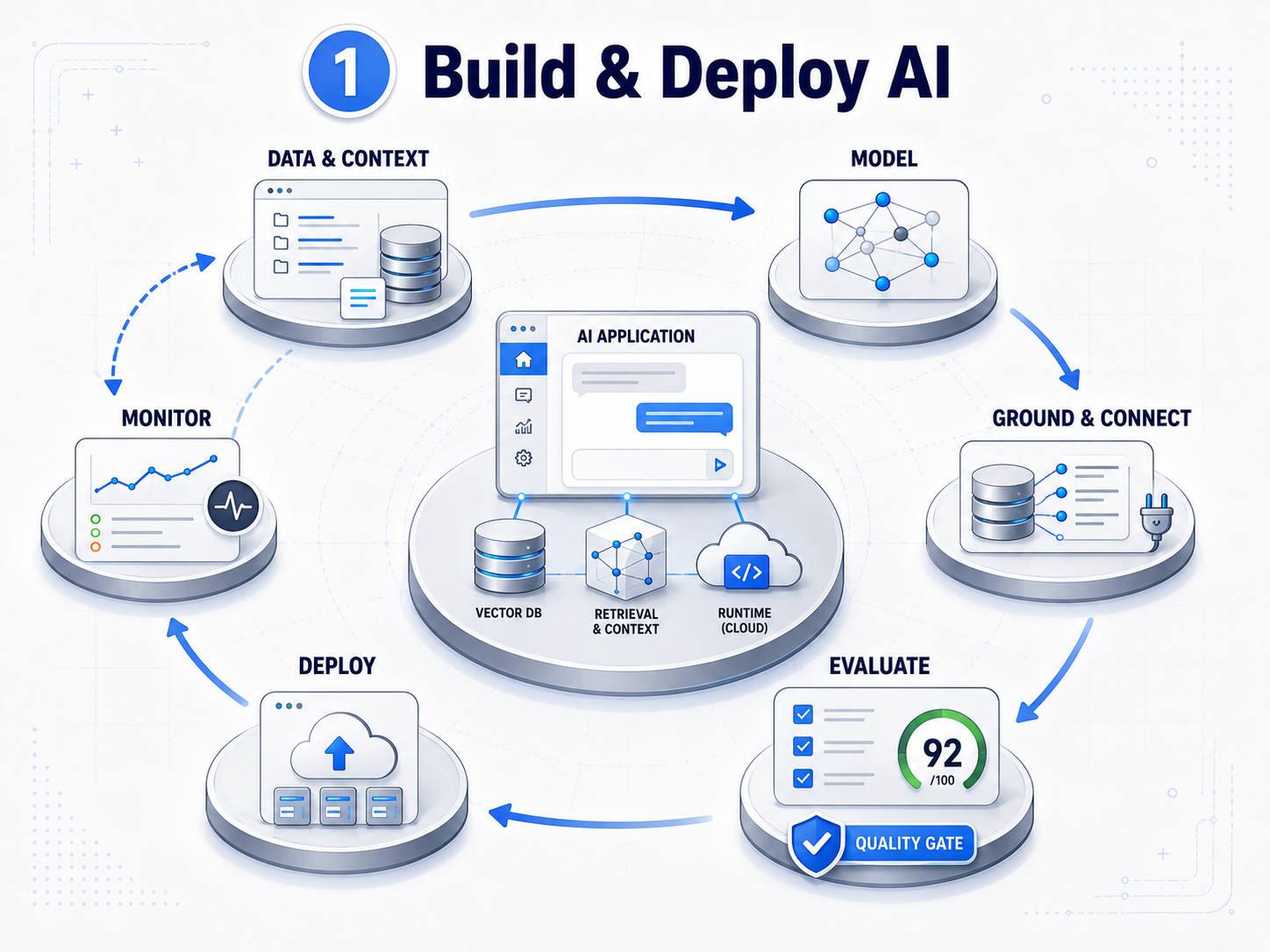
Conceptual Story
Section titled “Conceptual Story”An AI application is not simply an ordinary application with a model attached. Part of its behaviour is probabilistic: the same type of input can produce different outputs, and plausible output can still be wrong. The AI engineer therefore creates reliability around an inherently imperfect component.
The story starts with understanding the model family. Classical machine learning learns mappings from data; deep learning learns representations with neural networks; LLMs generate language and other modalities token by token. A useful application then supplies the model with the right context, grounds it in trusted data, gives it tools where necessary and arranges model calls into a workflow. Evals guide every iteration. Production engineering adds security, observability, cost control, latency management and feedback loops.
Concepts in This Area
Section titled “Concepts in This Area”Machine Learning
Methods that learn patterns from data instead of expressing every rule explicitly.
Deep Learning
Machine learning using multilayer neural networks, underpinning modern vision, speech, multimodal systems and LLMs.
Foundation Models and LLMs
Foundation models, LLMs, multimodal models and model selection as production engineering choices.
LLM Learning
How LLMs learn through pretraining and post-training, and how runtime adaptation differs from changing model weights.
LLM Training Example: Git
A worked example of how model training and agent engineering combine to produce reliable procedural Git competence.
Prompt Engineering
Designing instructions and examples that elicit useful model behaviour.
Context Engineering
Designing the complete information environment available to a model at a particular step.
Context Engineering in Practice
Dynamic context design across selection, memory, retrieval, trust, token budgets, compression and tool-feedback loops.
Grounding and RAG
Connecting model output to trusted, task-relevant sources or system state.
Embeddings, Vector Search, Graphs and Semantic Layers
Retrieval building blocks and their trade-offs for semantic, structured and relationship-heavy information.
Tool Calling and MCP
Allowing models to request controlled operations through validated tools and standard interfaces.
Agent Interoperability: A2A Alongside MCP
Designing auditable task handoffs between independent agents across runtime and vendor boundaries.
Agentic Workflows and Harnesses
Multi-step model workflows, harness responsibilities, state, memory and reusable workflow patterns.
Evals and Error Analysis
Structured tests and qualitative inspection for improving probabilistic AI-system behaviour.
Production Operations, Observability, Cost and Latency
Running AI systems under real deployment, tracing, reliability, cost and performance constraints.
Human Oversight and Guardrails
Controls that constrain AI inputs, outputs or actions and keep human authority meaningful.