
Using coding agents
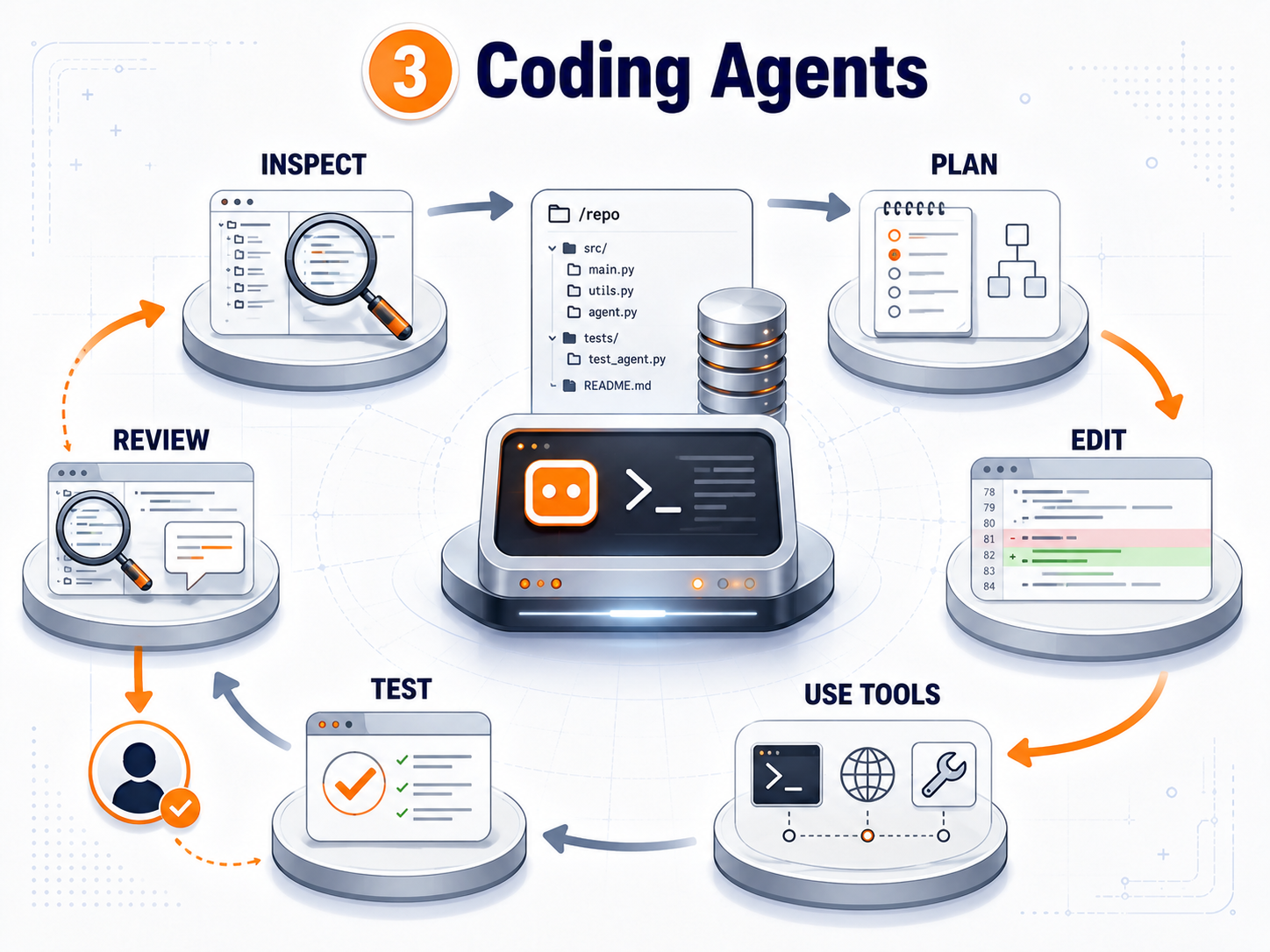
Conceptual Story
Section titled “Conceptual Story”A coding assistant proposes code in response to a local request. A coding agent can pursue a goal through multiple steps: inspect a repository, search files, form a plan, edit code, run commands, observe test results and revise its work. Its practical competence comes from the combination of model, harness, tools, context, permissions and feedback.
The human role shifts from writing every line to shaping the agent’s working environment and controlling the engineering loop. High-quality agent work begins with a bounded task, relevant context, clear constraints and verifiable completion criteria. The engineer then reviews evidence, not merely fluent explanations or a large diff.
Multiple agents add another level. Independent tasks can be delegated in parallel, or specialised roles can be coordinated in a workflow. This can reduce context pollution and elapsed time, but it adds token cost, communication loss, edit conflicts and orchestration overhead. Multi-agent design is therefore an engineering choice, not a maturity badge.
Concepts in This Area
Section titled “Concepts in This Area”Coding Assistants Versus Coding Agents
The difference between local code help and goal-directed multi-step agent work.
Model, Harness, Tools and Workspace
The practical components that determine what a coding agent can do.
The Agent Loop
Observe, reason, act, inspect, update and stop or continue.
Context, Instructions and Planning
Managing finite context, persistent project guidance, skills and adaptive plans.
Configuration, Permissions and Sandboxing
Model configuration, MCP integrations, execution boundaries, approvals and secrets.
Principles for Effective Use
Operational principles for getting useful, reviewable and reversible work from coding agents.
The Ten-Step Working Method
A readable process for directing coding agents from task framing through shipping and observation.
Task Briefs and Examples
A reusable task brief structure for bounded, verifiable agent work.
Multiple Agents and Subagents
When separate agents help and when a single agent is the better engineering choice.
Delegation, Handoffs and Orchestration
How orchestrators assign, combine and account for work across agents.
Multi-Agent Patterns
Fan-out/fan-in, pipelines, reviewer patterns and debate patterns.
Coordination Risks and Concurrency Safety
Cost, context, communication, conflict and stopping-condition risks in multi-agent work.
Evaluating Coding Agents
Evidence dimensions for judging agent output, process quality, safety and robustness.
Governance and Human Decision Boundaries
Where humans retain authority over risk, irreversible action and release decisions.
Coding Agent Tool Profiles
Concrete operating principles for Codex, Claude Code and Gemini Code Assist.