
Trustworthy Agency and Evaluation
Why It Matters
Section titled “Why It Matters”Long-lived social agents introduce risks that single-turn benchmarks miss: stale memories, identity drift, dependency formation, hidden persuasion, privacy erosion, boundary drift, unwanted initiative and relationship manipulation.
Normative architecture represents and enforces behavioral norms. It includes constitutional rules, role norms, user preferences and situational policies. These layers can conflict, so the harness needs explicit mediation, approval gates and audit trails.
Autonomy should be budgeted. Initiative, scope, consequence, reversibility, social sensitivity and temporal span all affect whether an agent may act without fresh approval. More autonomy is not automatically better; it is justified only where the user can understand, revoke and audit it.
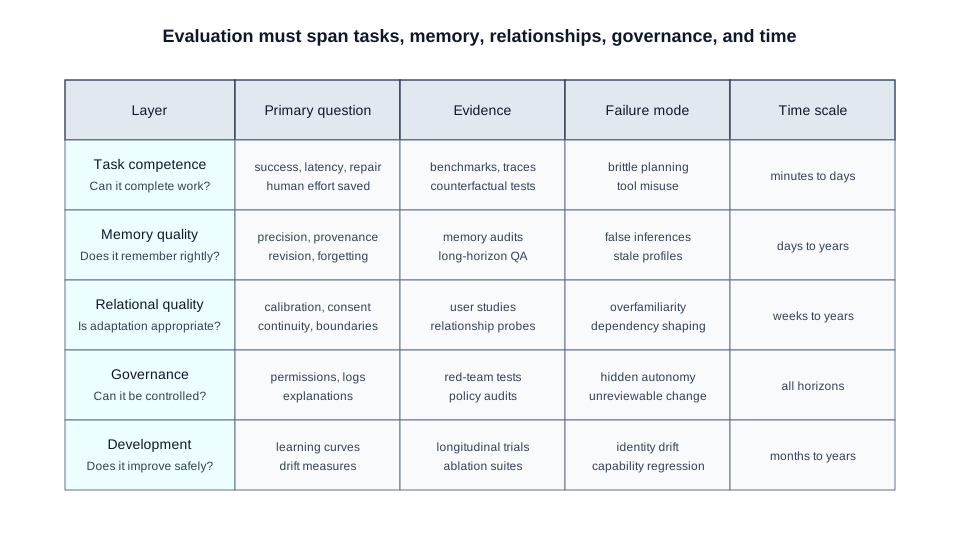
Evaluation must be multi-timescale. It should cover task competence, memory quality, relational quality, governance, development and robustness across sessions, projects and longer relationships.