
Memory Systems
Why It Matters
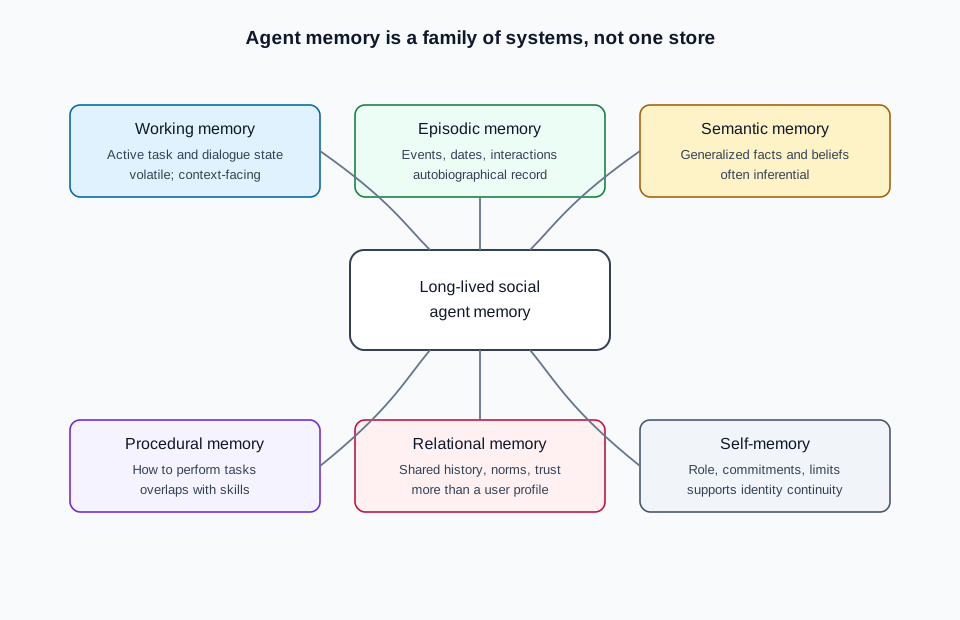
Section titled “Why It Matters”Long-lived agents need several memory types. Working memory supports the current interaction. Episodic memory records dated events. Semantic memory stores generalized facts and abstractions. Procedural memory stores ways of doing things. Relational memory stores expectations, boundaries, trust history and shared projects. Self-memory stores the agent’s own commitments, identity-relevant history and allowed capabilities.
These memories should not be collapsed into one vector store. A user-stated fact, an inferred preference, an unresolved hypothesis and a relationship norm have different authority. The system should know which is which.
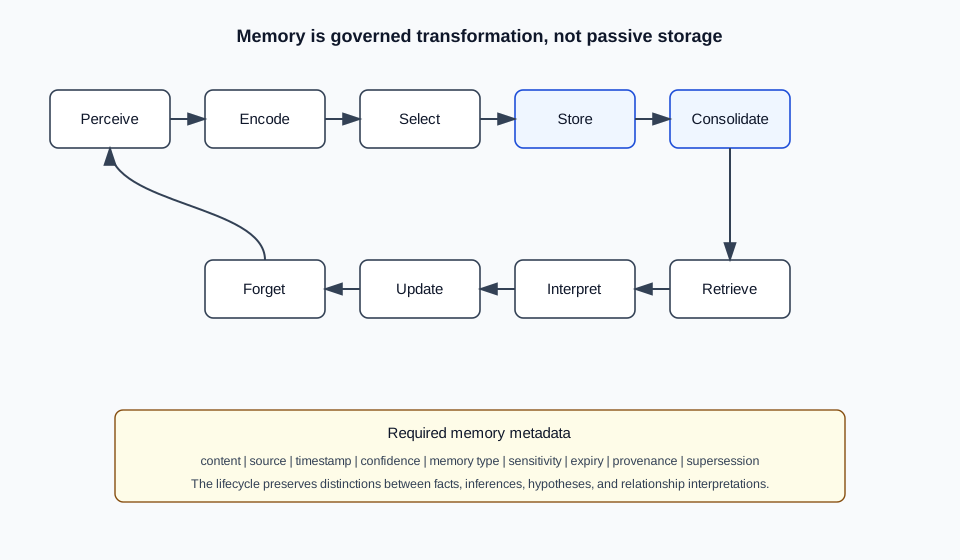
A useful memory lifecycle includes perception, encoding, selection, storage, consolidation, retrieval, interpretation, update and forgetting. Forgetting is a capability: obsolete preferences, sensitive disclosures, corrected misunderstandings and stale project details should not keep steering behavior just because they remain retrievable.