
Shaping the build
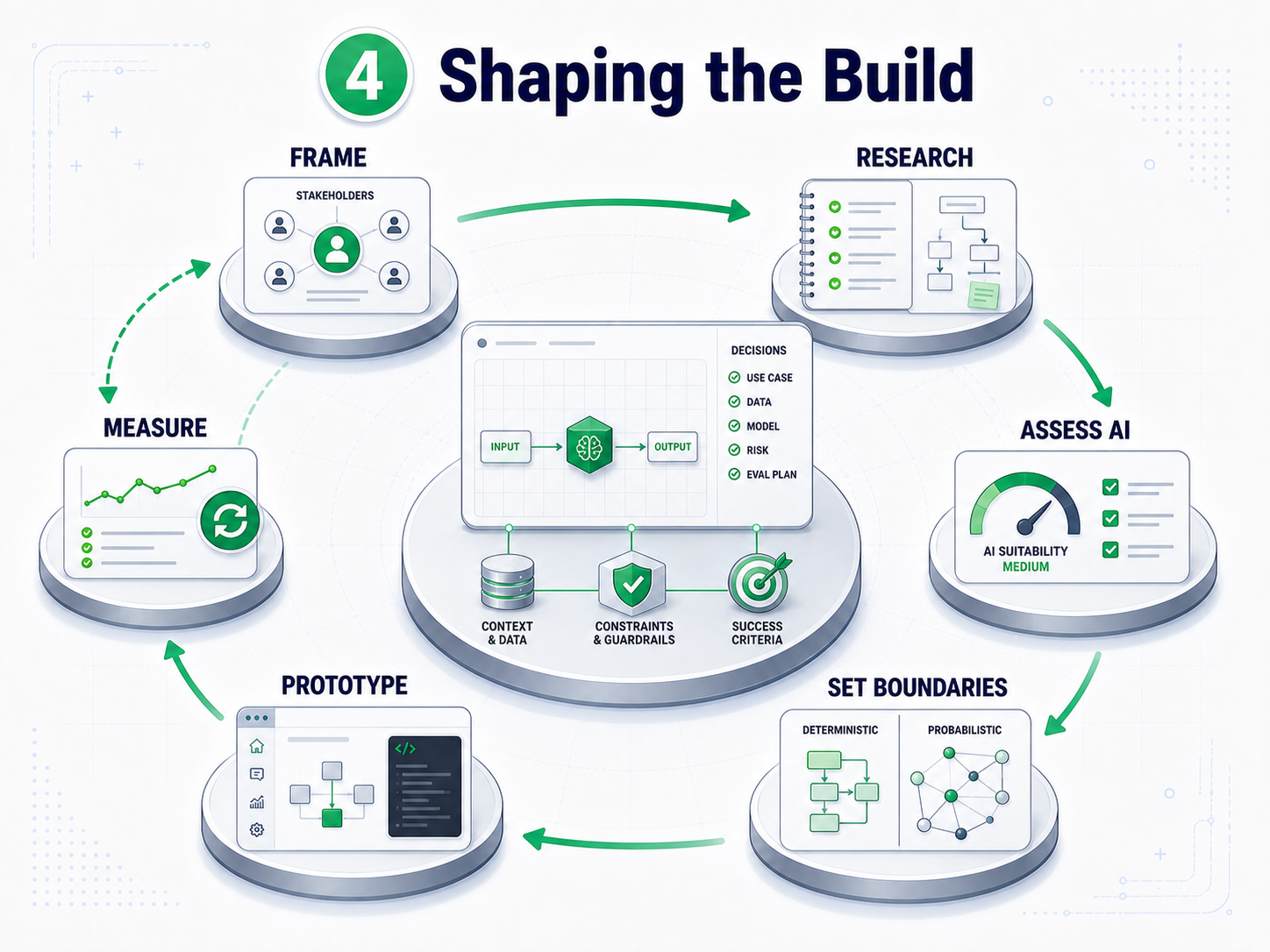
Conceptual Story
Section titled “Conceptual Story”When implementation becomes faster, choosing and defining the right build becomes the scarce skill. Shaping the build means turning an ambiguous situation into a valuable, feasible, responsible and testable intervention. It includes deciding whether AI belongs in the solution at all, which part of a workflow it should support, what remains deterministic and where humans retain authority.
The engineer studies users, work practices, domain rules, organisational constraints and potential harms. Alternatives are expressed as small testable slices. Quality is translated into acceptance criteria and evals before large-scale implementation begins. Success is measured in outcomes, not in model impressiveness or quantity of generated code.
Concepts in This Area
Section titled “Concepts in This Area”Problem Framing and Stakeholder Analysis
Defining the situation, affected people, desired change and competing interests before selecting an AI solution.
User and Workflow Research
Understanding tasks, handoffs, exceptions and user progress before changing a workflow.
AI Suitability
Assessing whether AI belongs in the task and whether errors are detectable, tolerable and recoverable.
Deterministic-Probabilistic Boundaries
Deciding what belongs in rules or conventional code and what can responsibly use a model.
Value, Feasibility, Viability and Responsibility
Four tests for deciding whether a shaped AI intervention deserves further investment.
Product Hypotheses and Prototypes
Testing falsifiable product hypotheses with prototypes and vertical slices.
Specifications, Quality Attributes and Acceptance Criteria
Turning desired behaviour, constraints and quality into verifiable conditions.
Risk and Responsible AI
Assessing hazards and designing accountable AI systems with meaningful human oversight.
Outcomes and Learning Loops
Outcome metrics, guardrail metrics, build-measure-learn loops and decision records.