
Context Engineering
Why It Matters
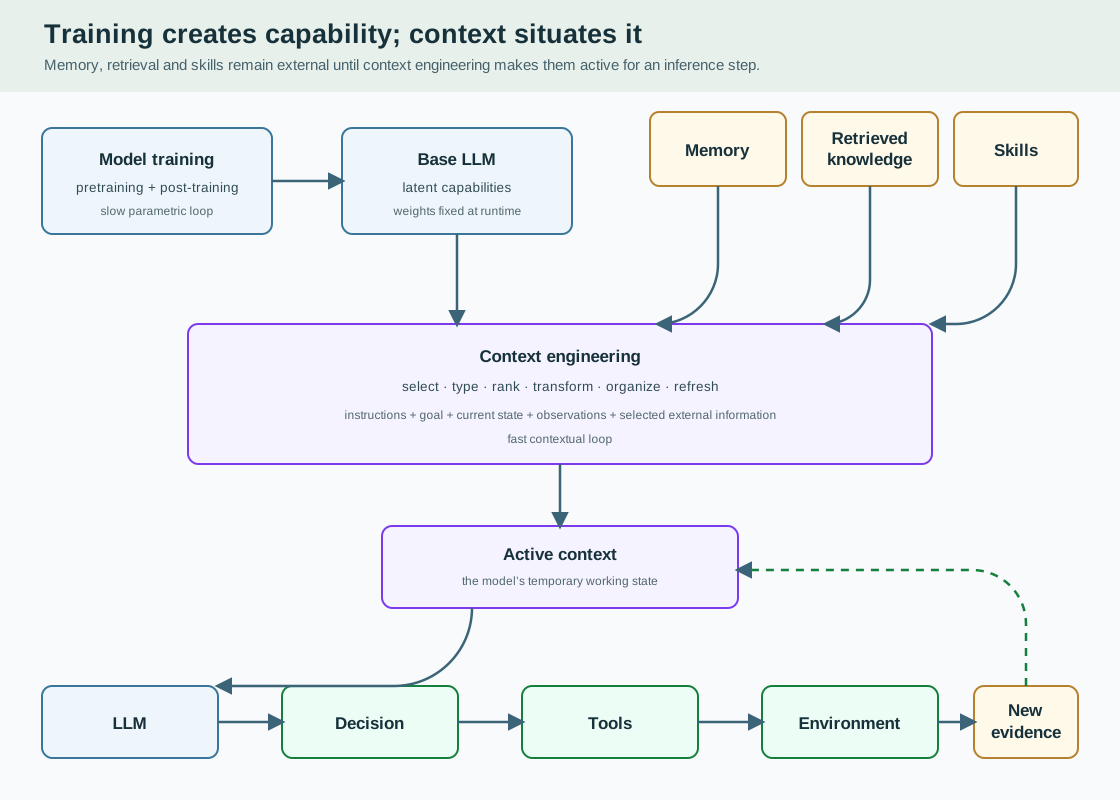
Section titled “Why It Matters”Context engineering designs the complete information environment available to a model at a particular step: instructions, conversation, retrieved knowledge, tool definitions, state, examples and output constraints.
It also includes selecting, compressing, ordering and refreshing context. The central engineering judgement is deciding what the model needs now, what should remain outside the model, and how stale, conflicting or sensitive context should be handled.
For agentic systems, this becomes dynamic state management across perception, reasoning and action cycles. Agentic context engineering is the dynamic management of the agent’s working state as new observations, tool results and decisions arrive.
More Than Prompt Wording
Section titled “More Than Prompt Wording”Prompt engineering asks how an instruction should be phrased. Context engineering asks the broader runtime question: what should the model know right now, from which sources, with what authority and in what form?
That is why context engineering includes retrieved documents, memory, tool observations, project or organizational policy, conversation state and reusable skills. Prompt wording is one part of the job, not the whole job.
Context Changes During Work
Section titled “Context Changes During Work”A coding or workflow agent does not operate from one static prompt. Suppose an agent is asked to upgrade an API client, repair tests and commit the result. At the start, the useful context may be the goal, project rules, active branch, Git policy and the current dependency version.
After the edit, failing tests become more important than the original file listing. After the tests pass, the diff becomes the key evidence. The model can stay the same while the context changes throughout the task.
Training, Context and Harnesses
Section titled “Training, Context and Harnesses”Context engineering sits between model learning and agent execution.
| Layer | What it contributes |
|---|---|
| Model learning | Latent capabilities such as language, coding and reasoning patterns |
| Context engineering | The current goal, policy, state, memory, retrieved knowledge and observations |
| Agent engineering | The controlled loop of choosing actions, using tools, observing results and updating state |
This separation matters operationally. Training creates capabilities in model parameters. Context engineering situates those capabilities for the present task. The harness then turns situated reasoning into accountable action.