
LLM Learning
From Data to Tokens
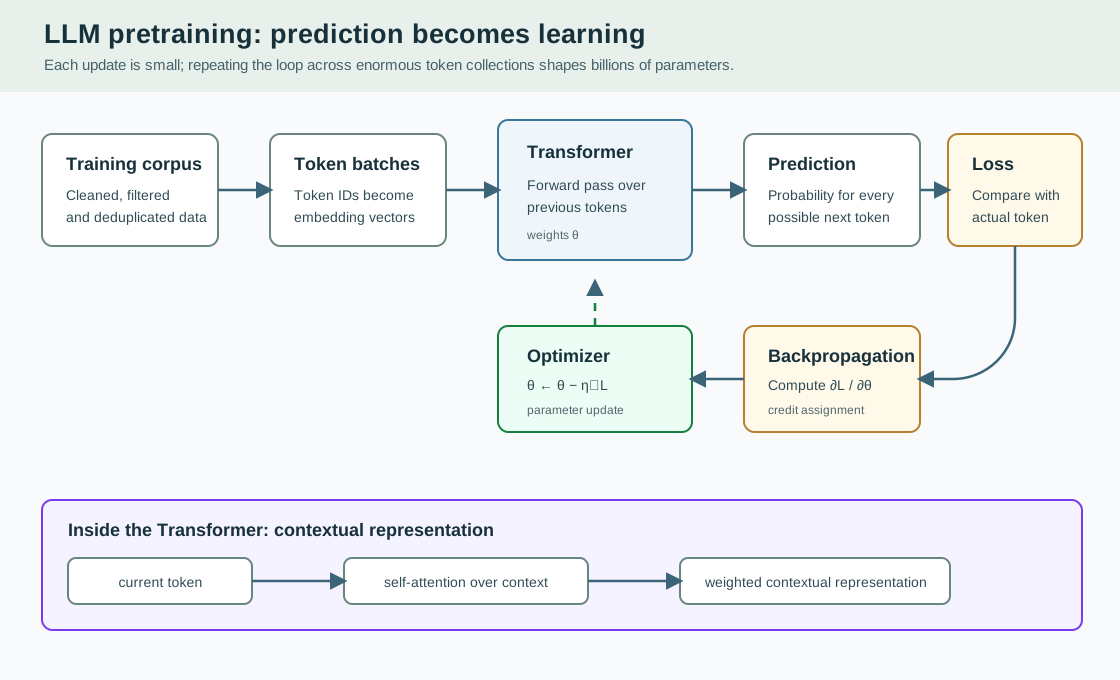
Section titled “From Data to Tokens”Training starts with a large corpus that may include books, websites, documentation, scientific articles, code, conversations and structured text. Multimodal models can also learn from images, audio or video. Before training, data engineering filters low-quality or unwanted content, removes duplicates, identifies languages, balances sources and constructs suitable examples.
The corpus is not simply installed as a searchable database. It supplies examples from which the model learns statistical and structural regularities.
An LLM processes tokens, not words directly. A tokenizer might split a sentence approximately like this:
["Artificial", " intelligence", " is", " useful", "."]Each token receives an integer ID, which is mapped to an embedding: a vector containing many learned numbers. Early in training these vectors contain little useful structure. Training gradually organizes them into representations that capture relationships between tokens and contexts.
Next-Token Prediction
Section titled “Next-Token Prediction”The central pretraining task for most generative LLMs is simple to state: given all previous tokens, predict the next one. For the sequence The capital of France is, the model produces a probability distribution over its vocabulary rather than a single answer.
| Candidate token | Example probability |
|---|---|
| Paris | 0.52 |
| Lyon | 0.08 |
| France | 0.05 |
| London | 0.03 |
Because the actual next token is known during training, a loss function can score the prediction. Cross-entropy loss for the correct token y is:
L = -log P(y)Assigning Paris probability 0.52 gives a loss of about 0.65; assigning it probability 0.01 gives a loss of about 4.61. Better predictions therefore produce lower loss.
Backpropagation and Parameter Updates
Section titled “Backpropagation and Parameter Updates”The model contains parameters in its embeddings, attention layers, feed-forward networks and projection matrices. Backpropagation computes how the loss changes with respect to each parameter:
partial loss / partial parameterAn optimizer then performs a small update, commonly summarized as:
new parameters = old parameters - learning rate * loss gradientOne optimization step may change billions of parameters by tiny amounts. Training groups many token sequences into batches, combines their losses, and repeats forward pass, loss calculation, backward pass and update across enormous numbers of examples.
Attention and Representation Learning
Section titled “Attention and Representation Learning”Self-attention lets each token representation weigh relevant information from earlier tokens. In simplified form:
Attention(Q, K, V) = softmax(QK^T / sqrt(d_k)) VQueries, keys and values allow attention heads to capture different relationships, including nearby syntax, long-distance references, semantic similarity and structural patterns.
The network also performs representation learning. Humans do not need to define features such as “is a noun,” “topic” or “sentence length” in advance. Across its layers, the model learns increasingly contextual features useful for prediction. This should not be read as a rigid one-concept-per-layer hierarchy: knowledge is distributed across many parameters and activations.
Predicting diverse text rewards representations of:
- language, including grammar, syntax, spelling and discourse;
- concepts and relations, such as Amsterdam being a city or Paris being the capital of France;
- recurring reasoning patterns, including comparison, analogy, calculation and causal argument;
- styles and genres, from source code and scientific papers to conversation and legal language.
No individual parameter normally represents one fact such as “France.” The capability emerges from distributed computation across the network.
Pretraining and Post-Training
Section titled “Pretraining and Post-Training”Large-scale next-token training is called pretraining. It builds a base or foundation model that can already complete text, summarize, translate, answer some questions and write code.
A raw next-token predictor is not automatically a useful assistant. Post-training shapes how it responds to users. Supervised fine-tuning (SFT) increases the likelihood of high-quality demonstrated responses. Preference methods compare plausible answers and optimize toward the preferred behaviour. This family includes RLHF, RLAIF, reward modelling and Direct Preference Optimization (DPO).
| Pretraining | Post-training |
|---|---|
| Learns broad patterns and capabilities | Shapes behaviour and task use |
| Uses enormous, broad datasets | Uses smaller, curated datasets |
| Is mostly self-supervised | Uses demonstrations, preferences or rewards |
| Is extremely compute-intensive | Is usually smaller in scale |
A useful shorthand is that pretraining teaches which patterns exist, while post-training teaches how to use capabilities as an assistant. The boundary is not absolute: post-training can add capabilities, and pretraining also influences behaviour.
Preference Learning
Section titled “Preference Learning”For one prompt, a model can generate several plausible responses. Human or AI evaluators can rank them. Training then raises the probability of preferred response patterns, such as following instructions, staying relevant, communicating clearly and avoiding unsafe behaviour. Preference learning does not make these properties guaranteed; it shifts model behaviour statistically and still requires application-level evaluation and controls.
Conversation Is Usually Not Weight Learning
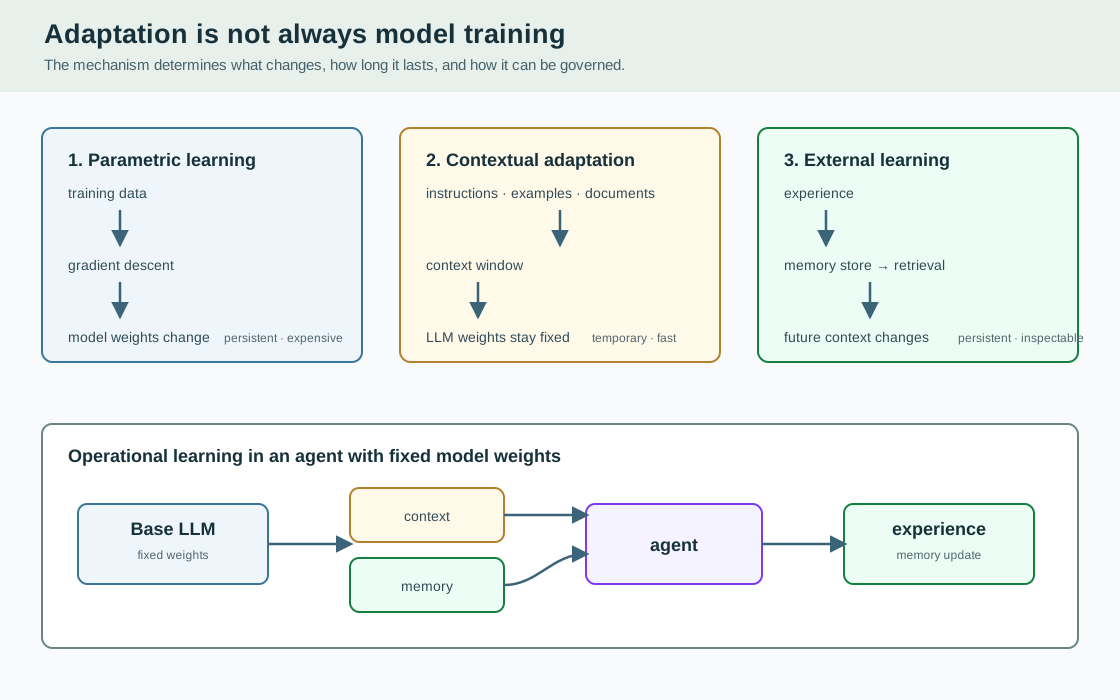
Section titled “Conversation Is Usually Not Weight Learning”During normal use, model weights are fixed. If a user says, “My project is called Apollo,” the model can use that fact later in the same context, but no backpropagation has occurred. This is in-context learning: the model applies a pattern, definition or example supplied in its current input.
The difference matters because several mechanisms can all look like “learning” from the outside:
| Mechanism | Changes model weights? | Persistence |
|---|---|---|
| Prompt or context | No | Current context |
| Retrieval-augmented generation | No | External knowledge store |
| Agent memory | No | External persistent memory |
| Fine-tuning | Yes | Persistent |
| Continued pretraining | Yes | Persistent |
| Full retraining | Yes | Persistent |
Learning Versus Remembering
Section titled “Learning Versus Remembering”Learning changes a system’s ability to perform a class of tasks. Remembering makes earlier information available again. Fine-tuning a model to improve medical coding is learning in its parameters. Retrieving a user’s preference for concise explanations is remembering through external state.
An agent can therefore learn operationally even when its underlying LLM does not learn parametrically. A memory system can record experience, retrieval can place relevant records into a future context, and the fixed model can respond differently. External memory is often easier to inspect, correct, delete and govern than information embedded in model weights.
From Model Learning to System Capability
Section titled “From Model Learning to System Capability”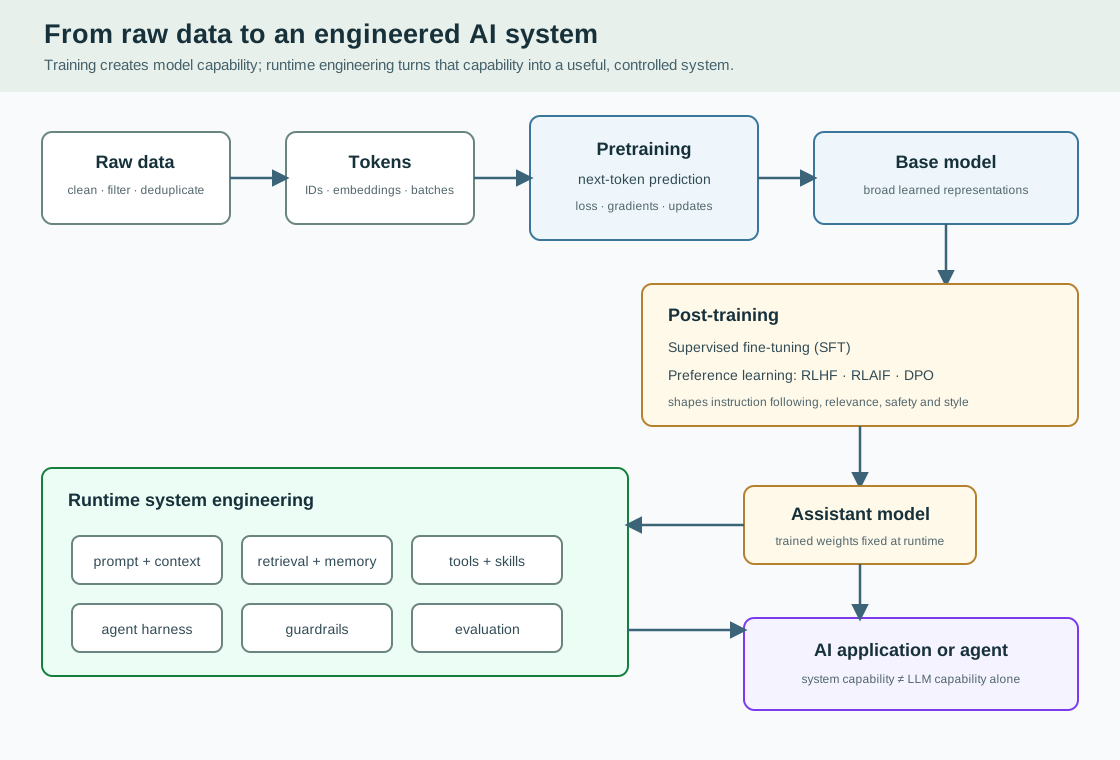
Next-token prediction can produce sophisticated capabilities because accurate prediction over diverse data requires modelling latent structures. Continuing equations rewards arithmetic patterns; continuing code rewards knowledge of syntax, APIs and algorithms; continuing explanations rewards modelling premises, conclusions and causal relationships.
Once the model is trained, most application engineers do not train it again. They build a runtime system around it. The resulting capability comes from the model plus context, retrieval, memory, tools, skills, the agent harness, guardrails and evaluation. Model capability is therefore a component of AI system capability, not its complete definition.