
Social AI
Conceptual Story
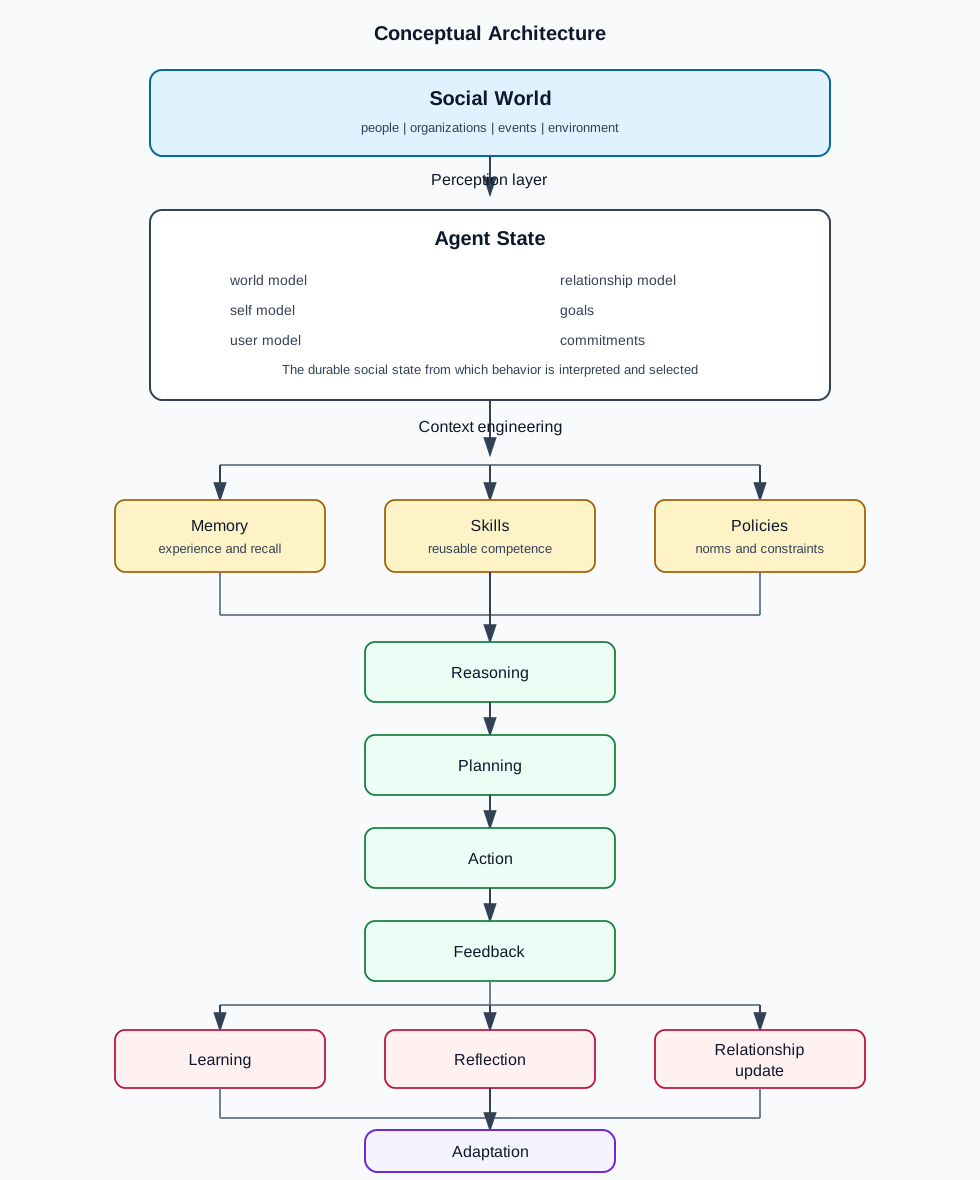
Section titled “Conceptual Story”Social AI studies agents whose behavior is organized around ongoing interaction with people. The important unit is not a single prompt or model completion, but a persistent system that maintains state, memory, goals, skills, identity, relationship models, policies and evaluation over time.
A long-lived adaptive social AI agent is a model-independent agentic system. The foundation model supplies reasoning and generation, but continuity lives in the harness: the governed architecture that decides what is remembered, what is forgotten, which skills are available, which actions require approval, and how adaptation is validated.
This section extends the agent concepts already used elsewhere in the knowledge base into social settings: personalization is not enough; the agent must represent the user, itself, the relationship and the social context without collapsing observation, inference and commitment into one hidden profile.
Concepts in This Area
Section titled “Concepts in This Area”Foundations of Agency
The perception-action loop, state, goals, environment and autonomy as the basis of social agents.
Agent Cognition
Reasoning, planning, world models, reflection and metacognition in persistent agents.
Agent Harness
The runtime architecture that binds models, context, memory, tools, policies and evaluation into governed agency.
Memory Systems
Working, episodic, semantic, procedural, relational and self-memory, plus lifecycle governance.
Skills and Goals
Reusable procedural competence, goal typing and skill learning without opaque self-modification.
Adaptation and Development
Contextual, memory-based, policy, skill and model adaptation across multiple time scales.
Long-Lived Identity
Identity continuity, layered stability and model migration for agents that persist for years.
Social State and Relationships
User models, self models, relationship models, theory of mind, social norms and relational memory.
Co-adaptation and Trust
Negotiated adaptation, calibrated trust, repair, uncertainty and user agency in social AI.
Trustworthy Agency and Evaluation
Alignment, bounded autonomy, uncertainty, privacy, safety, governance and multi-timescale evaluation.