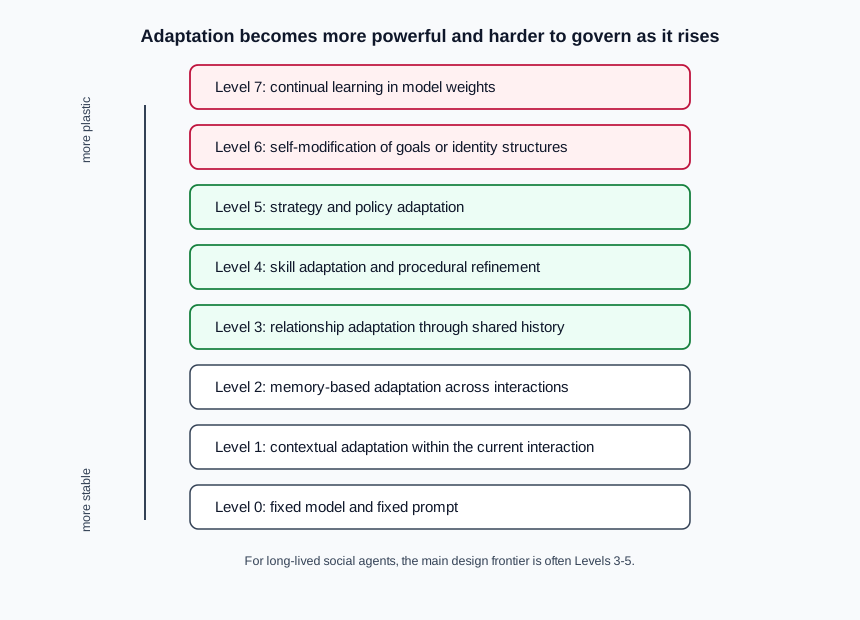
Adaptation is often used too loosely. A social agent can adapt within the current context, through persistent memory, through behavioral policy, through skill revision or through model-weight changes. These mechanisms have different risk profiles.
For long-lived social agents, prefer adaptation through context, memory, policy and skills before model weights. These layers are easier to inspect, explain, version, reverse and govern. Model adaptation can be useful, but it raises harder problems around consent, auditability, cross-user leakage, catastrophic forgetting and identity drift.
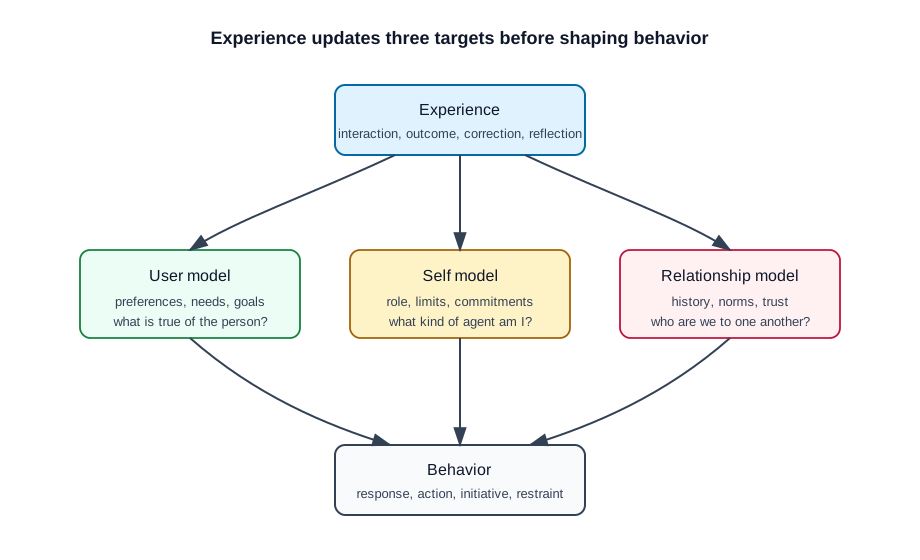
Social adaptation also has multiple targets. Experience may update the user model, the agent’s self model or the relationship model. Keeping these separate prevents personalization from being mistaken for relational development.